When to harvest white oyster mushrooms
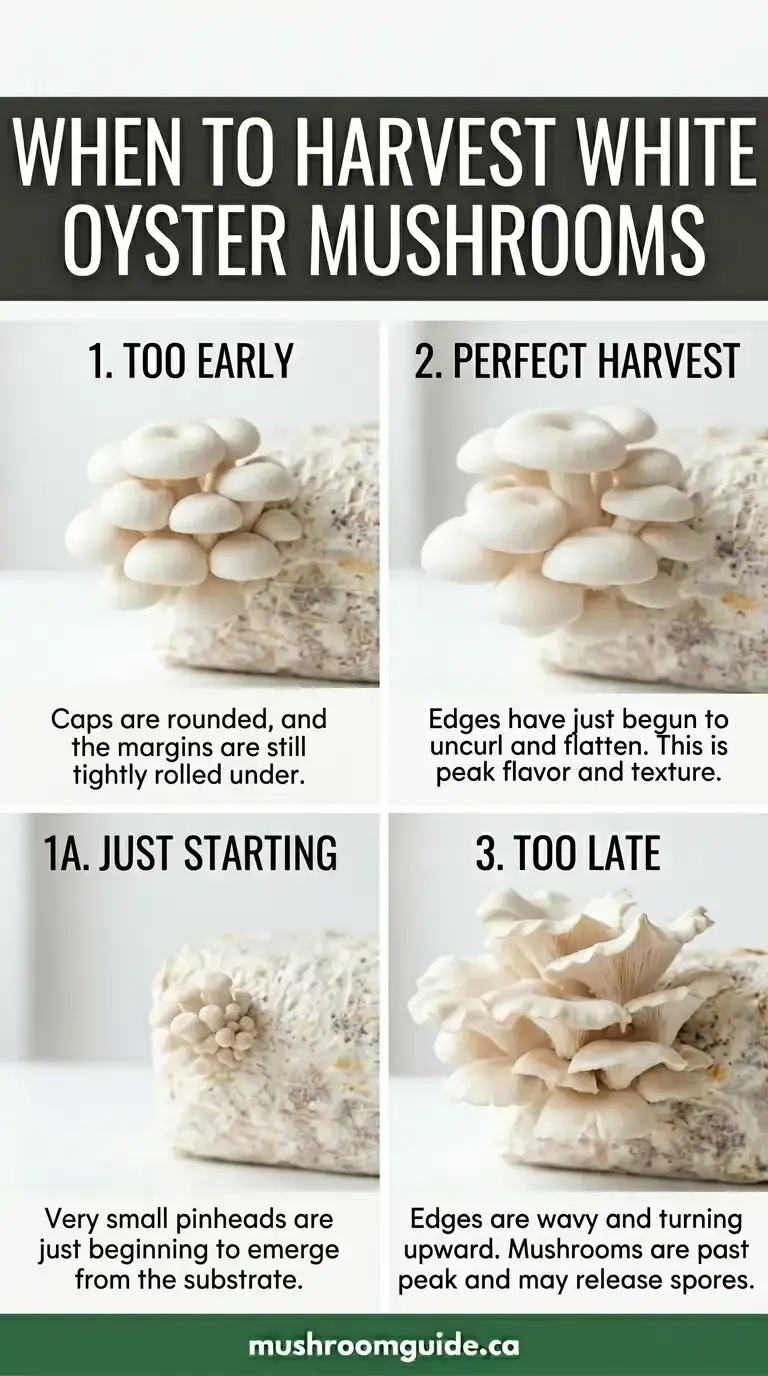
White oyster mushrooms — also sold as pearl oyster — are the species most Canadian grocery stores stock when they stock oyster mushrooms at all. They’re the workhorse oyster: productive, forgiving, and the easiest variety for first-time growers. Botanically they’re Pleurotus ostreatus, the same species as grey oyster — just a paler strain.
This post is about getting the harvest timing right. The cues are similar to other oysters but the visual signals are subtler because the colour doesn’t shift as dramatically with maturity.
TL;DR
- Harvest 5–7 days after pinning at 16–22 °C
- Pick when caps are mostly flat and edges are just starting to lift — same as grey oyster
- Colour fades only slightly as they mature — rely more on cap shape than colour
- Forgiving species — harvest window is wider than pink or yellow
The white oyster timeline
| Stage | Days from pinning | What you see |
|---|---|---|
| Primordia | Day 0 | Tiny pale-grey or cream-coloured dots on substrate or air-cuts |
| Early pins | Day 1–2 | Recognizable mini-mushroom shapes, pale cream |
| Cap formation | Day 2–4 | Distinct cap-and-stem shape, caps strongly curled under |
| Harvest window | Day 5–7 | Caps mostly flat, edges still down or just lifting |
| Past prime | Day 7–9 | Caps fully wavy and uplifted, sporulation beginning |
| Spoilage risk | Day 9+ | Sour or musty smell, slimy edges |
That window — day 5 through day 7 — gives you about 48 hours of forgiveness, more than you get with pink or yellow oysters (which peak inside a 24-hour window).
The three harvest cues
1. Cap shape — flat with edges just lifting
The most reliable signal. White oyster caps progress through three stages:
- Cupped under (edges tucked) → too early. The cluster looks like a tight bunch of dumplings.
- Mostly flat with edges still curled down or just barely lifting → perfect. The cluster looks like a fan of pancakes.
- Wavy and uplifted with gills visible from the side → past prime.
Knife the harvest at the second stage. The texture is firmest and the storage life longest at this point.
2. Colour — pale cream to off-white, only slightly fading
White oyster colour doesn’t shift as dramatically as blue or pink. Young clusters are bright pearly-white; mature clusters fade to a slightly duller cream or pale buff. This change is much less obvious than with blue or pink oysters.
That makes colour an unreliable cue with this variety. Don’t wait for a dramatic colour shift — by the time it’s visibly faded, you’re probably past prime.
Use cap shape as your primary cue, colour as a secondary confirmation.
3. Sporulation — white dust = harvest immediately
Once you see a fine white powder accumulating on lower caps, on the substrate surface, or on the fruiting chamber walls, the cluster is actively releasing spores.
White oyster spores are — appropriately — white, which makes them harder to spot than the brown sporulation of shiitake or the heavy white-on-substrate of blue oyster. Look at the cluster from below. If you see haze around the lower gills, harvest now.
How white oyster differs from grey, blue, pink
| Trait | White / pearl | Grey | Blue | Pink |
|---|---|---|---|---|
| Fruiting temp | 13–22 °C | 13–22 °C | 10–18 °C | 18–30 °C |
| Pin-to-harvest | 5–7 days | 5–7 days | 5–7 days (longer in cold) | 4–6 days |
| Colour | Pale cream | Beige-grey | Slate blue | Magenta pink |
| Storage (fridge) | 7–10 days | 7–10 days | 7–10 days | 3–5 days |
| Beginner-friendly? | ✅ Most | ✅ Yes | ✅ Yes (cool grow) | ⚠️ Narrow window |
| Sporulation | Heavy | Heavy | Very heavy | Heavy |
Functionally, white and grey oyster are very close. If you’re growing indoors and your strain is “pearl” rather than “grey,” everything in our grey oyster harvest content also applies.
What to do if you missed the window
Slightly past prime (caps wavy, no smell): still fine. Trim any dried or papery edges with scissors, refrigerate, use within 2 days. Texture will be slightly tougher when cooked.
Visible sporulation (no smell): harvest immediately, ventilate the room before opening the chamber, wear an N95. Cut off any spore-coated lower caps if possible, refrigerate, use that day.
Sour or musty smell: compost. Bacterial spoilage in oysters has caused documented food poisoning — don’t push it. White oyster cluster bases at the substrate interface are common spots for early bacterial breakdown; sniff the bottom of the cluster specifically.
Cluster has dried out (papery, brittle): still salvageable as mushroom powder. Tear into pieces, run through a coffee grinder. Use to season stocks and seasoning blends.
Yield expectations for white oyster
Per 5 lb (2.3 kg) substrate block, across two flushes:
- Masters Mix: 2.5–3.5 lb (1.1–1.6 kg) fresh
- Pasteurized straw: 1.5–2.5 lb (700–1100 g) fresh
- Supplemented sawdust: 2–3 lb (900–1400 g) fresh
These are roughly identical to grey oyster. Use our yield estimator for your specific setup.
Storage
White oysters are among the best-keeping oysters:
- Refrigerator (2–4 °C) in a paper bag: 7–10 days
- Refrigerator in vented plastic clamshell: 5–7 days
- Dehydrated and stored airtight: 6+ months
- Frozen (sautéed first): 3 months
The dense, slightly thick caps of white oyster — especially when harvested at peak — hold structural integrity better than thin caps of pink or yellow.
Full details in how to store oyster mushrooms.
In the kitchen
White oysters have the mildest flavour of the cultivated oyster family — a clean, slightly nutty, very mushroom-y taste without the “meaty” intensity of pink/yellow or the woodier character of blue.
This makes them:
- The best oyster for picky eaters or for kids being introduced to mushrooms
- The most versatile in cuisine — they don’t fight Asian, Italian, French, or Mexican applications
- The best “base” mushroom in a mixed stir-fry alongside other vegetables and proteins
For technique-specific cooking, see air fryer oyster mushrooms — the dry-sauté-then-crisp method works exactly the same for white as for grey.
For comparison with the other Pleurotus species and lion’s mane, see king oyster vs oyster vs lion’s mane.
Spore safety reminder
Wear an N95 mask when harvesting and ventilate the room. White oysters are heavy sporulators — even a “perfect” harvest releases visible (though white-on-white, harder to see) spore clouds when you handle the cluster.
Repeated unmasked spore exposure can cause hypersensitivity pneumonitis (“mushroom worker’s lung”). Wearing the mask is a habit worth building from your first grow.
Next in the harvest series: When to harvest blue oyster mushrooms — the cool-fruiting cousin. When to harvest pink oyster mushrooms — the fastest oyster. When to harvest king oyster mushrooms — a completely different timing rulebook.