Chestnut mushrooms: the gourmet rising 450%
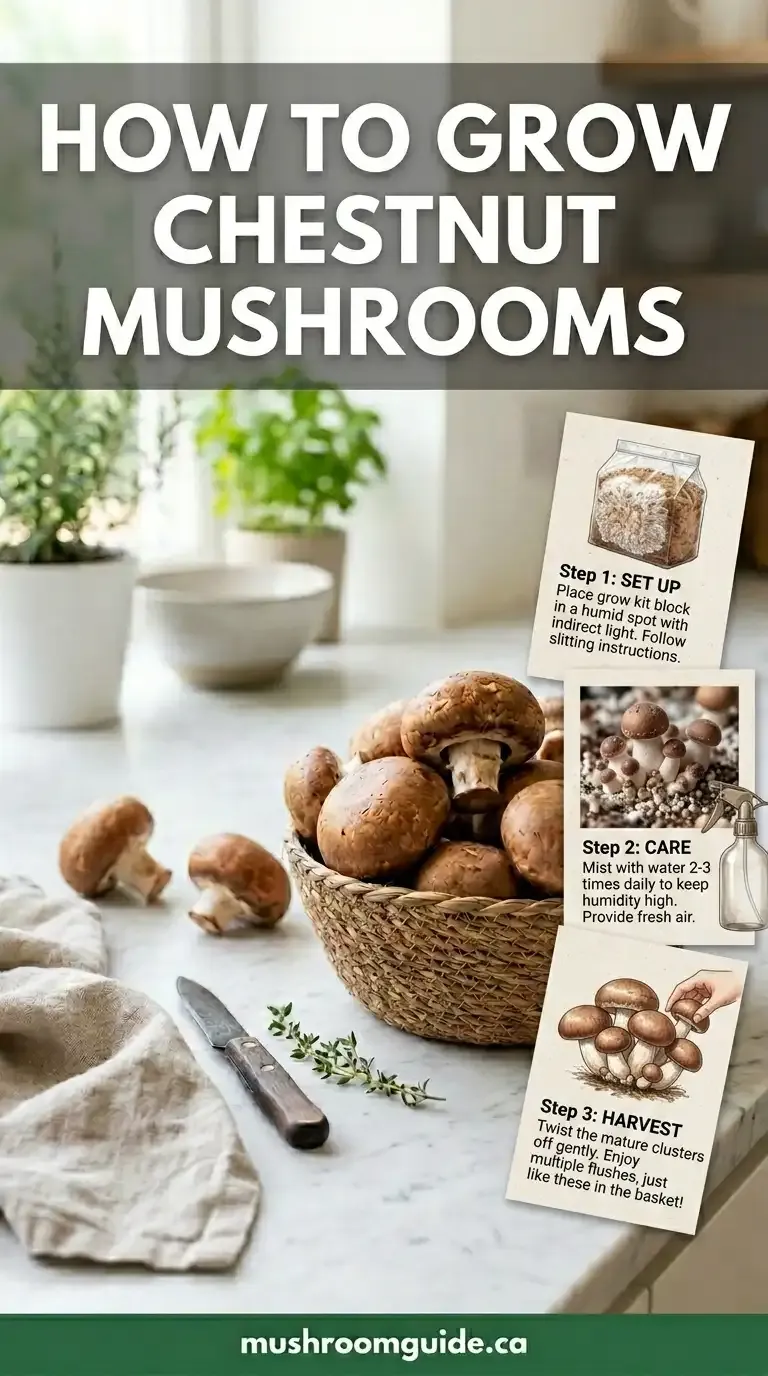
If you’ve never heard of chestnut mushrooms (Pholiota adiposa), you’re not alone. They’re not in Canadian grocery stores. They’re not on restaurant menus. They’re not even on most “common mushroom species” lists.
And yet — Google Trends data shows Canadian searches for “chestnut mushrooms” are up 450% over the past five years. Something has shifted, and growers are paying attention.
This post covers what they are, why interest is exploding, and how to grow them yourself (because, again, you can’t buy them).
What chestnut mushrooms actually are
Pholiota adiposa — sometimes sold as Pholiota nameko’s larger cousin — is a wood-rotting fungus native to East Asia and parts of Europe. The mushrooms are:
- Caramel-brown to deep mahogany in colour, with a slick, slightly sticky cap surface when fresh
- Clustered, often in tight bouquets of 10–30 small to medium fruiting bodies on a single block
- Crunchy in a way that genuinely sets them apart — the stems and caps stay snappy through cooking
- Mildly nutty in flavour, often described as “chestnut” or “hazelnut” with a slight sweetness
They are not the same as “chestnut cremini,” which is a marketing name for brown button mushrooms (Agaricus bisporus). True chestnut mushrooms are a different species and a different experience entirely.
Why interest is exploding
Three forces are converging on this species:
1. Texture-seeking is the new flavour-seeking
Home cooks are increasingly looking for ingredients with crunch. King oyster has had its moment as “vegan scallop.” Lion’s mane is “crab cake.” Chestnut mushrooms are now positioned as the crunchy mushroom — they hold their texture in stir-fry, in soup, in pickles, even after freezing.
2. They’re easy to grow
Chestnut mushrooms are about as forgiving as oyster for a beginner:
- Fruit well on the same supplemented hardwood sawdust as lion’s mane and shiitake
- Tolerate Canadian basement temperatures (12–24 °C)
- Don’t require dramatic temperature shocks to trigger fruiting
- Produce reliable, photogenic clusters (excellent for social-media documentation of a first grow)
3. They’re not available at the grocery store
Almost nobody sells fresh chestnut mushrooms in Canada. North Spore (US) sells the spawn; a handful of Canadian commercial growers sell fresh fruit at farmers’ markets in Vancouver and Toronto. That’s it.
“Can’t buy it = have to grow it” is the strongest possible signal for a home-cultivation market. This is why “chestnut mushrooms” as a query is breaking out while “oyster mushrooms” is merely growing.
How they grow
Substrate
Best on supplemented hardwood sawdust (80% hardwood sawdust + 18% wheat bran + 2% gypsum). Masters Mix works too, with slightly lower yield. They don’t love straw.
Use our substrate calculator to size your mix.
Spawn ratio
Standard: 5–10% grain spawn by weight of finished substrate. Higher end of that range if your sterile work is iffy — more spawn = faster colonization = less window for contamination.
Colonization
- Temperature: 22–25 °C
- Time: 14–21 days for a fully colonized 5 lb (2.3 kg) block
- Look for: white mycelium, no green/black spots, occasionally a faint yellow exudate (normal — Pholiota can stain slightly yellow during colonization)
Fruiting
This is where chestnut mushrooms shine for hobby growers — they don’t require dramatic conditions.
- Temperature: 15–22 °C (lower end = better colour and texture)
- Humidity: 85–95%
- Fresh-air-exchange: moderate (use our fruiting chamber calculator to size)
- Light: 12 hours/day of indirect light
- Pinning trigger: drop the temperature 5 °C for 48 hours if pins aren’t appearing after a week at fruiting temperature
Pins emerge as tiny dark-brown bumps and develop into recognizable mushrooms over 4–6 days. The harvest window is forgiving — you have 1–2 days of grace once caps flatten.
Yield
Expect 1.5–2.5 lb (700–1100 g) fresh fruit per 5 lb (2.3 kg) block across two flushes. Lower than oyster but higher value if you’re growing for personal use (because you can’t buy them).
Use our yield estimator for your specific setup.
Cooking with chestnut mushrooms
The crunch is the whole point. Cook them in ways that preserve it.
Quick stir-fry (the default)
- Halve large clusters; leave small ones whole.
- Hot pan, 1 tablespoon neutral oil, high heat.
- Toss for 4–5 minutes — they release very little water.
- Salt at the end, splash of soy sauce.
That’s it. They don’t need garlic or aromatics to taste good (though they tolerate them well).
Pickled chestnut mushrooms
The texture handles pickling beautifully. Simmer in equal parts rice vinegar + water + a tablespoon of sugar and a teaspoon of salt for 5 minutes. Pack into a jar with ginger, peppercorns, and a bay leaf. Refrigerate. Ready in 2 days, lasts 3 weeks.
Roasted as a side dish
Toss with olive oil and salt, roast at 425 °F (220 °C) for 20 minutes, shaking once. Finish with a squeeze of lemon and fresh thyme.
What not to do
- Don’t slice thin — you lose the textural point of the species.
- Don’t braise for hours — they become tough, not tender.
- Don’t deep-fry — the cap moisture creates spitting, and the natural crunch is lost in the batter.
Where to get spawn in Canada
- North Spore (US): Best variety selection, ships to Canada with duty and shipping fees. Worth it for a first grow.
- Sporeworx (Toronto): Carries chestnut spawn intermittently.
- MycoSupply (BC): Limited selection.
- Forest Garden Mushrooms (Vancouver Island): Local sourcing if you’re in BC.
Inventory rotates — check directly before assuming availability.
How chestnut compares to other “starter” species
| Species | Beginner-friendly? | Yield | Speciality value | Crunch |
|---|---|---|---|---|
| Oyster (any) | ✅ Very | High | Low (in stores) | Low |
| Lion’s mane | ✅ Yes | Medium | High | Medium (after cooking) |
| Shiitake | ⚠️ Longer | Medium | Medium | Medium |
| King oyster | ✅ Yes | Medium | Medium | High |
| Chestnut | ✅ Yes | Medium | Very high | Very high |
If you’ve already done one oyster grow and want a second species that will surprise you, chestnut is the answer.
Spore safety reminder
Wear an N95 mask when harvesting and ventilate the room. Chestnut mushrooms aren’t as heavy a sporulator as oyster or lion’s mane, but they still release enough spores to cause hypersensitivity pneumonitis (“mushroom worker’s lung”) with repeated unmasked exposure.
Related: How to grow chestnut mushrooms in Canada — full cultivation guide with substrate, fruiting, and harvest steps. King oyster vs oyster vs lion’s mane — taste comparison of the cultivated gourmet species. Which mushroom should you grow first? — chestnut is a strong second-grow species. Yield estimator — plan your chestnut harvest before you start.