Pet-safe mushrooms: every common variety for dogs & cats
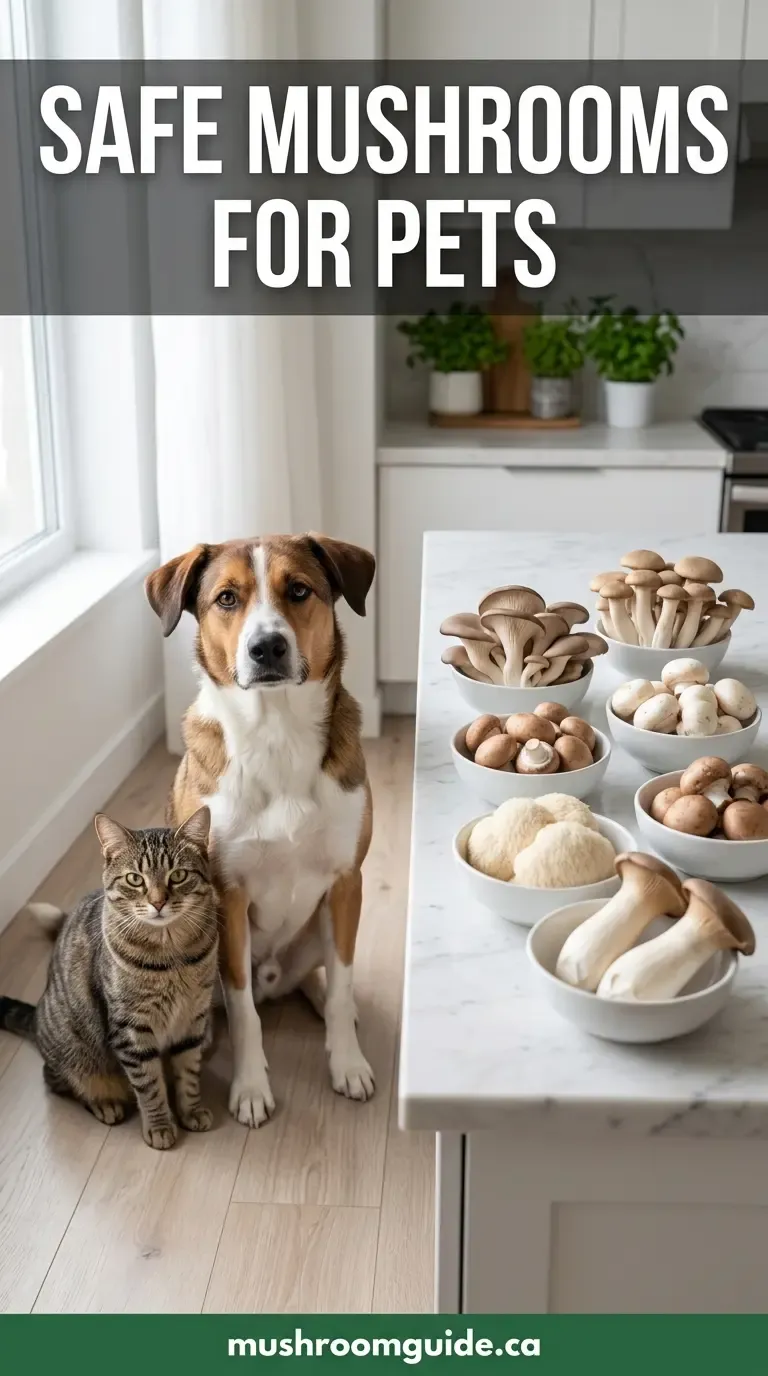
This is the hub page for everything we publish about mushrooms and pets. If you’re looking for the quick answer on a specific species, the table below covers every common cultivated mushroom. If you want the full reasoning, scroll down — or follow the variety-specific links.
This is not veterinary advice. If your pet has eaten a wild mushroom or any quantity of an unknown mushroom, call your vet or the Pet Poison Helpline (1-855-764-7661) immediately.
The quick-reference table
Cultivated mushrooms (the kind you grow or buy)
| Mushroom | Dogs | Cats | Notes |
|---|---|---|---|
| Oyster (any colour) | ✅ Cooked plain | ✅ Cooked plain | No seasoning, no oil, no garlic. Full post → |
| King oyster | ✅ Cooked plain | ✅ Cooked plain | Same rules as regular oyster. |
| Lion’s mane | ✅ Cooked plain | ✅ Cooked plain | Tear small; large pieces are choking hazards. |
| Shiitake | ⚠️ Small amounts only | ⚠️ Small amounts only | Remove tough stems. Some dogs are sensitive — start with one piece. |
| Cremini / button / portobello | ✅ Cooked plain | ✅ Cooked plain | Safe but not nutritionally beneficial. |
| Chestnut (Pholiota adiposa) | ✅ Cooked plain | ✅ Cooked plain | Same as oyster. |
| Enoki | ⚠️ Small amounts | ⚠️ Small amounts | Long thin strands can cause choking or GI obstruction. |
| Maitake | ✅ Cooked plain | ✅ Cooked plain | Generally safe. |
Wild mushrooms
| Category | Dogs | Cats | Notes |
|---|---|---|---|
| Any wild mushroom | ❌ Never | ❌ Never | If your pet ate a wild mushroom, call your vet immediately. Don’t wait for symptoms. |
Cooked-with seasonings (the real danger)
| Seasoning | Dogs | Cats |
|---|---|---|
| Onion, garlic, leek, chive (any allium) | ❌ Toxic | ❌ Toxic (more sensitive than dogs) |
| Butter, heavy oil | ❌ Pancreatitis risk | ⚠️ GI upset |
| Salt (more than a pinch) | ⚠️ Avoid | ⚠️ Avoid |
| Xylitol (in some marinades, sauces) | ❌ Toxic | ⚠️ Avoid |
| Soy sauce, miso, fish sauce | ⚠️ Too salty | ⚠️ Too salty |
If your dog ate a human dish containing mushrooms, the danger is almost always the seasoning — not the mushroom itself.
The two universal rules
Rule 1: Cooked plain, always
Raw mushrooms are difficult for dogs and cats to digest — chitin (the structural material in fungal cell walls) is largely indigestible without heat-softening. Even safe species can cause vomiting or diarrhea when fed raw.
Cooked plain means: steamed, simmered, or sautéed without oil, salt, or seasonings. Plain water in a hot pan for 3–4 minutes is enough.
Rule 2: Never wild
This rule applies regardless of the species you think it is, your identification confidence, your forager-friend’s opinion, or the photo-ID app. The deadliest mushrooms in Canada — Amanita phalloides (death cap), Galerina marginata, Cortinarius species, Amanita virosa (destroying angel) — can kill from a single small dose, and symptoms often appear 6–24 hours after the damage is already done.
Dogs find wild mushrooms by smell. Some toxic species smell appealing to them. This is a real and documented problem in BC, southern Ontario, parts of Quebec, and the Maritimes — anywhere death caps and related species have established.
If your pet eats a wild mushroom:
- Remove access; collect a sample (whole mushroom, including the base).
- Photograph the mushroom and the area where it was growing.
- Call your vet or Pet Poison Helpline (1-855-764-7661) immediately.
- Do not induce vomiting unless instructed.
Variety-specific guides
We have full, detailed posts for the most-searched species:
- Can dogs eat oyster mushrooms? — Full TL;DR table, why raw isn’t great, the allium and pancreatitis problems, dog-safe recipe.
- Shiitake for dogs (coming soon) — including why “small amounts” is important.
- Are mushrooms safe for cats? (coming soon)
Why pets are attracted to mushrooms
Dogs investigate mushrooms because of:
- Smell — many mushrooms have strong, savory aromas that are appealing to canine olfaction
- Texture — chewy, satisfying for some dogs
- Curiosity — anything new and ground-level gets investigated
Cats are less interested in cultivated mushrooms but have a documented attraction to Amanita muscaria (the iconic red-and-white “fairy-tale” mushroom) — likely from compounds related to those that make catnip and silver vine appealing. If you grow mushrooms indoors and have a curious cat, keep the fruiting chamber sealed or inaccessible.
Recipe: how to feed your pet plain cooked mushrooms
For a one-time treat, both dogs and cats:
- Take 1–2 small mushrooms (~30 g for a medium dog, ~10 g for a cat).
- Tear or chop into bite-sized pieces.
- Steam or simmer in plain water for 4 minutes.
- Drain well; let cool to room temperature.
- Offer 1 piece as a test. Wait 24 hours before offering more if it’s their first time, in case of individual sensitivity.
No oil, no seasoning, no garlic, no salt — ever.
Signs of a problem after mushroom exposure
Whether wild or cultivated, watch for:
- Vomiting or diarrhea (most common, can appear within hours)
- Drooling
- Loss of appetite
- Lethargy
- Stumbling, weakness, tremors
- Yellowing of gums, whites of eyes, or skin (liver involvement — emergency)
- Dark or reduced urine output (kidney involvement — emergency)
- Pale gums (anemia from allium ingestion)
- Seizures
Any of these symptoms after mushroom exposure is a veterinary emergency. For wild-mushroom exposure, treat any symptom as an emergency. For cultivated-mushroom exposure with significant seasoning, treat as an emergency.
Bottom line
Cultivated mushrooms, cooked plain, in small amounts: fine for most dogs and cats. The risk lives in the seasoning, the quantity, the raw preparation, and — overwhelmingly — in wild mushrooms.
If you keep two rules — cooked plain, never wild — you’ve handled 95% of the pet-safety question. The rest is variety-specific nuance that the variety pages cover.
This is not veterinary advice. Always check with your veterinarian before introducing new foods to your pet, especially if your pet takes medication or has existing health conditions.
Dogs — by mushroom: Can dogs eat oyster mushrooms? — the most-searched dog-and-mushroom question. Can dogs eat king oyster mushrooms? — the dense-stemmed “scallop” mushroom. Can dogs eat button mushrooms? — white, cremini and portobello. Can dogs eat cooked mushrooms? — why the seasoning, not the mushroom, is the danger.
Cats — by mushroom: Can cats eat mushrooms? — the full cat guide across every species. Can cats eat oyster mushrooms? Can cats eat king oyster mushrooms? Can cats eat button mushrooms?
More: Air fryer oyster mushrooms — the cooking technique, sized for humans; halve, skip salt for pets. King oyster vs oyster vs lion’s mane — species reference for the cultivated mushrooms in this guide. Disclaimer and foraging policy — this site does not publish wild-mushroom identification content.