How to grow shiitake mushrooms in Canada
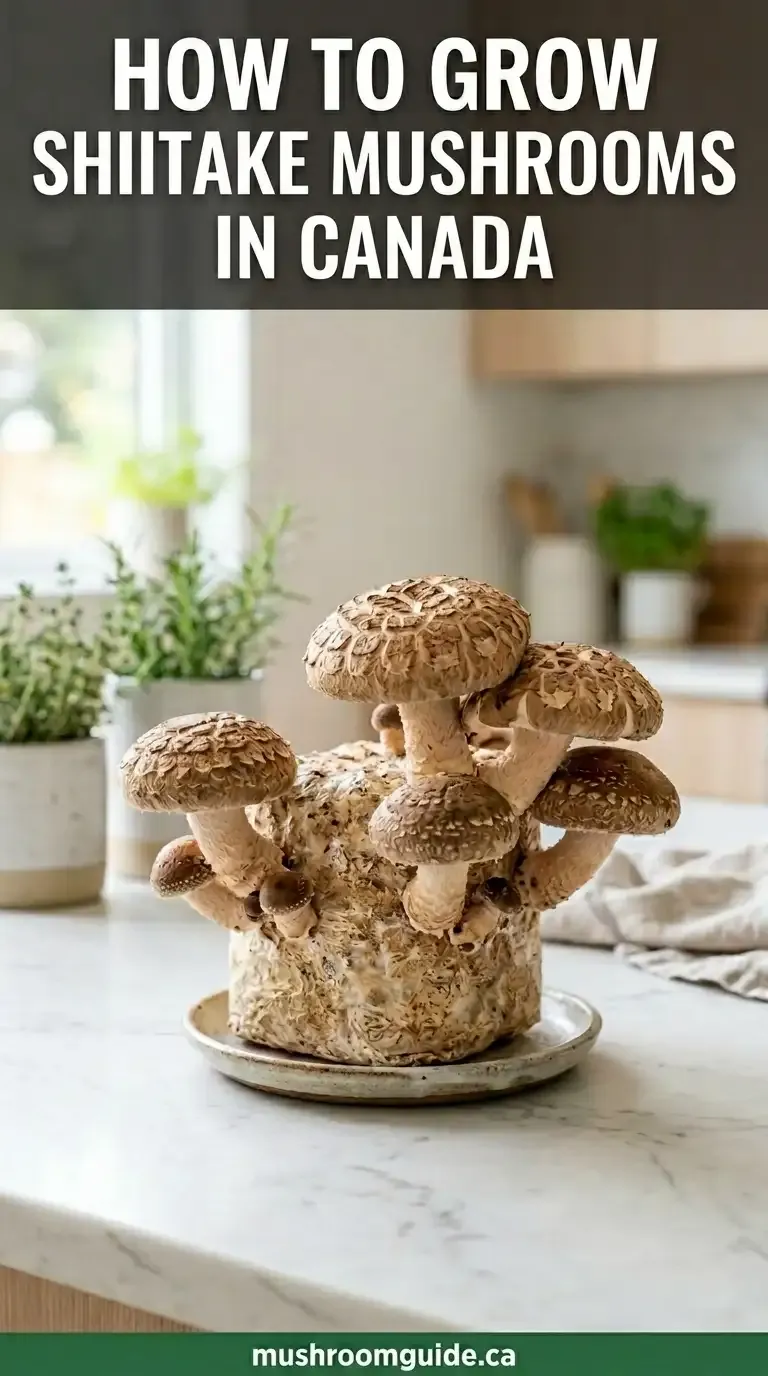
Shiitake (Lentinula edodes) is the world’s second-most cultivated mushroom and a staple of East Asian cuisine. It’s also the slowest of the common gourmet species — your first harvest is 12+ weeks away on the bag method, 12+ months away on the log method.
That patience is the only real difficulty. Shiitake is forgiving on contamination, tolerant of CO₂ swings, and doesn’t need the high fresh-air-exchange that lion’s mane demands. If you can wait, it’s a rewarding species.
This guide is Canada-first and covers both methods.
TL;DR
- Two methods: bag (indoors, 12–14 weeks to first harvest) or log (outdoors, 12–18 months to first harvest, then 4–5 years productive)
- Substrate (bag): supplemented hardwood sawdust
- Substrate (log): freshly cut hardwood log, 90–120 cm × 10–20 cm diameter
- The “browning” phase: weeks 6–12 of bag colonization, the block turns chocolate-brown — this is required, not a problem
- Fruiting: 10–18 °C, moderate FAE (4 air changes per hour), 85–95% humidity
- First harvest: week 12–14 on bags, year 1–2 on logs
Why shiitake specifically
Reasons to grow it:
- The flavour is iconic — savoury, smoky, deeply umami, holds up in any cuisine
- Fresh shiitake is significantly better than dried — and fresh shiitake at Canadian grocery stores is often weeks old at $25/lb
- The log method is the lowest-effort cultivation in Canada — inoculate once, harvest for 4–5 years
- Lower contamination pressure than oyster or lion’s mane on the bag method
Reasons to choose a different species first:
- You’ll wait 12+ weeks for your first harvest. Oyster is 3–4 weeks.
- Bag method requires pressure sterilization. No pressure cooker → start with oyster on straw instead.
- Yields are lower per kg of substrate than oyster (about 25–35% vs 80–100% biological efficiency)
If this is your first grow ever, do oyster first. Pick shiitake as your second or third species.
Method A: Bag method (indoors)
Faster turnaround. Higher yield per square foot of growing space. Requires pressure cooker.
Substrate
The standard recipe is supplemented hardwood sawdust, same as lion’s mane:
- 80% hardwood sawdust (oak, maple, beech — anything dense; not cedar, pine, or other conifers)
- 18% wheat bran
- 2% gypsum
- Hydrated to 60% moisture
Use our substrate calculator for sizing.
Sterilization
Pressure cook at 15 PSI for 2.5 hours. Real pressure cooker — not an Instant Pot Duo on “high pressure.” See our best pressure cooker for mushroom growing in Canada guide for options.
Spawn
- Sawdust spawn is preferred for shiitake (better strain expression than grain spawn for this species)
- 5–10% by weight of finished substrate
- Order from Sporeworx (Toronto), MycoSupply (BC), or North Spore (US, ships to Canada)
Inoculation
- Inoculate in still air (a still-air box or in front of a flow hood)
- Crumble spawn evenly through the cooled, sterilized substrate
- Seal the bag
- Mix by shaking and squeezing
Colonization (weeks 1–6)
- Temperature: 21–24 °C
- Light: dark
- What you see: white mycelium spreads from each spawn site, eventually covering the entire substrate
This phase looks identical to lion’s mane colonization.
The “browning” phase (weeks 6–12)
This is the part that confuses beginners. After full colonization, shiitake blocks turn brown. The white surface darkens to tan, then chocolate-brown, sometimes with raised bumps and an uneven texture.
This is required for shiitake fruiting. It’s the strain forming its protective “skin” before fruiting. It is not contamination — even though it looks worrying.
Symptoms of healthy browning:
- Uniform tan to dark brown surface
- Bumpy, raised texture
- Possibly some pale or orange-tinted exudate (“mushroom sweat”) — normal, can be wiped off
- A faint, sweet, slightly nutty smell
Symptoms of actual contamination:
- Patches of bright green, pink, or black on the substrate
- Slimy or wet spots
- Sour or ammonia smell
If the colour is uniform and the smell is right, wait it out — even up to 12 weeks total. Don’t open the bag early.
Birthing the block
Once the block is fully browned (typically week 10–12):
- Cut the bag away completely. Yes, the whole bag — shiitake fruits from the entire block surface, not just from slits.
- Soak the naked block in cold water for 12–24 hours. This is the fruiting trigger — simulating heavy rain.
- Drain.
- Place in the fruiting chamber.
Fruiting
- Temperature: 10–18 °C (cooler than lion’s mane or oyster — this matters)
- Humidity: 85–95% RH
- FAE: moderate, 4 air changes per hour
- Light: 12 hours/day indirect light
- Mist daily to keep the block surface damp
Pins emerge from the block surface within 5–10 days as small brown bumps. They mature over the following 7–10 days.
Harvest
Pick when the caps are mostly flat or slightly upturned and the underside (gills) shows distinct ridges but hasn’t released spores. Twist gently to detach.
A 5 lb (2.3 kg) block produces 1.0–1.5 lb (450–700 g) fresh across 2–3 flushes. Use our yield estimator for your specific setup.
Between flushes, resoak the block in cold water for 12 hours and return to fruiting conditions. Each subsequent flush is smaller than the previous.
Method B: Log method (outdoors)
The classic, low-effort, long-running method. Inoculate once, harvest for years.
This is fully covered in our outdoor log inoculation guide — shiitake is the species the guide is mostly written around, since it’s the best log-cultivation species.
Quick summary:
- Cut fresh logs in March–April (before bud break)
- Inoculate within 2–4 weeks with plug spawn
- Drill, hammer in plugs, wax over
- Stack in shade, wait 12–18 months
- First flush triggers naturally with weather or via cold-water soak
- Productive 4–5 years, ~0.5–1 lb fresh per log per year
For all the details, see the log inoculation post.
Bag vs log: which to do?
| Bag method | Log method | |
|---|---|---|
| Time to first harvest | 12–14 weeks | 12–18 months |
| Yield per cycle | 1.0–1.5 lb / 5 lb block | 0.5–1 lb per log per year |
| Setup cost | Pressure cooker ($200+) + supplies | Drill + wax + plugs (~$60) |
| Setup time | 4 hours | 2 hours |
| Space needed | Indoor fruiting chamber | Shaded outdoor space |
| Productive life | One season (~3 flushes) | 4–5 years per log |
| Best for | Year-round indoor production | Set-and-forget outdoor patch |
Most Canadian growers do both. Bags for fast indoor harvests in winter; logs for low-effort spring/fall harvests in the yard.
Canadian regional notes
BC south coast
Mild winters and high ambient humidity = both methods work year-round. Logs fruit naturally with multiple weather-driven flushes per year.
Prairies
Bag method preferred — dry winters favour clean indoor cultivation. Log method works but the productive window is shorter (May to September); soak logs more often.
Ontario / Quebec
Both methods work well. Log inoculation in April; bags year-round indoors. Strong spring and fall outdoor flushes.
Atlantic Canada
Both methods work. High humidity favours log cultivation; watch for mold in extended damp stretches.
Far north
Bag method only is practical. Cold soil temperatures slow log colonization to multi-year times.
Cooking and storage
Shiitake stems are tough — trim and save them for stock. The caps are the eating product.
Best techniques:
- Pan-sauté sliced caps in oil + soy sauce + sesame
- Whole-cap grilling with oil and salt
- Dehydrated for stock — dried shiitake makes the best vegetarian stock you can make at home
For full storage details (fresh, frozen, dehydrated, powdered), see how to store oyster mushrooms — shiitake follows the same rules.
Spore safety
Wear an N95 mask when handling spawn, opening colonized blocks, and harvesting. Shiitake is a moderate sporulator; repeat unmasked exposure can cause hypersensitivity pneumonitis (“mushroom worker’s lung”).
A specific shiitake warning: shiitake dermatitis is a documented skin reaction to raw or undercooked shiitake (a streaky red rash called “flagellate dermatitis”). It’s caused by a heat-sensitive compound called lentinan. Always cook shiitake thoroughly — never eat raw.
Common failure modes
| Symptom | Cause | Fix |
|---|---|---|
| Block stays white, never browns | Strain hasn’t reached maturity, or temperature too low | Wait longer (up to 12 weeks); ensure 21–24 °C |
| Block browns then nothing pins | Hasn’t been cold-soaked yet | Soak in cold water 12–24 hours |
| Block fruits but mushrooms are tiny | Low humidity in fruiting chamber | Mist more often; check chamber RH |
| Browning surface is patchy with green spots | Trichoderma contamination | Toss and start over; cleaner sterile work |
| Logs sit for 2+ years with no fruits | Wrong wood, or no soak trigger | Soak logs overnight; confirm wood is hardwood |
| Shiitake caps come out malformed (curled, leathery) | FAE too low | More chamber ventilation |
Related: How to grow oyster mushrooms in Canada — the easiest first species. How to grow lion’s mane mushrooms in Canada — the seafood-like mushroom. Outdoor log inoculation — the log method in depth. Substrate calculator, fruiting chamber calculator, and yield estimator — all the math.
Safety & data: Mushroom worker’s lung: N95 spore-safety guide — the spore safety every grower needs. Common mushroom contamination — spot it and fix it. Mushroom growing conditions chart — temperature, humidity & timing for every species.